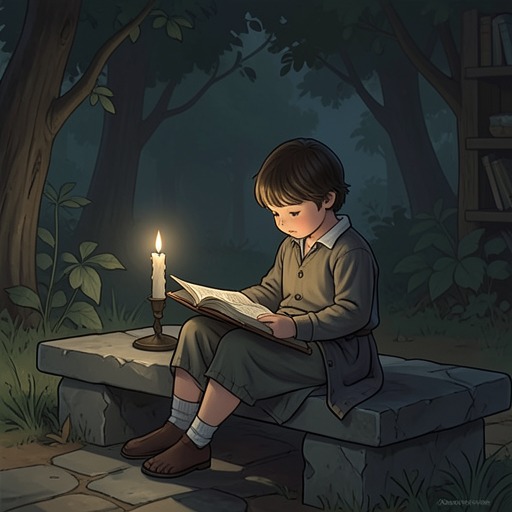
“Happily ever after”
The Changeling“Happily ever after” is the old man’s shorthand for the false certainty that a fairy tale can make an ending final. Recalling the Norwegian story of Askeladden, he argues that the familiar promise closes off the questions children ought to ask and trains families to pass an implausible assurance from one generation to the next. His proposed alternatives do not promise perfect resolution: they leave happiness as an effort, or challenge the idea that it can last forever.
The Promise and Its Target
The old man does not reject fairy tales outright. He distinguishes the stories themselves from the way they end, calling the closing formula the part that spoils them. The phrase compresses an indefinite future into a reassuring certainty: the hero’s victory appears to settle not only the immediate danger but everything that might follow. In his bitter formulation, those words “ruin everything” because they claim more than the adventure can establish.
His example is Askeladden, the youngest son in a Norwegian tale passed down through his family. The boy defeats monsters and comes away with treasure, a pattern the old man remembers as pleasant childhood listening. But victory over a monster is not the same as a settled life. The triumphant ending, he suggests, turns one completed deed into an unsupported promise about every later consequence. The contrast between the tale’s treasure and the worn, cramped living room he gestures toward gives his objection a material edge: stories may conclude in abundance, while ordinary life continues amid limits and unfinished business.
What the Ending Leaves Out
The old man tests the fairy-tale promise against inheritance. If Askeladden’s father becomes wealthy, he asks, can the family afford to send all three sons to university, and how would the father choose? The youngest has defeated the troll, but the oldest remains the firstborn; the question of who deserves the spoils therefore does not vanish with the victory. Nor does the father’s eventual death. A will, an equitable division of assets, legal counsel, and years of dispute are among the practical possibilities the ending suppresses.
These questions are pointedly mundane beside the monster tale, and that is their force. The old man brings property, education, family hierarchy, and law into the space supposedly secured by the fairy-tale conclusion. He does not claim that any particular dispute occurs in Askeladden’s family. Rather, he shows how much the promise leaves undecided. The magic ending treats success as if it settled the distribution of its rewards; his questions expose that assumption as a narrative convenience, not a consequence demonstrated by the story.
The omitted future is personal as well as financial. The old man imagines children asking whether Askeladden’s family celebrated his return, whether his brothers and father went into the woods to see where the troll had turned to stone, and whether he married and had children. Even the fate of the defeated monster remains a possible question. The ending stops precisely where curiosity would carry the story forward: from the spectacular encounter toward family life, memory, marriage, and the next generation.
A Bedtime Formula Passed Down
For the old man, the phrase also serves a social purpose. He pictures a tired parent who has told an extraordinary story, endured a child’s accumulating questions, and wants to sleep. The parent answers that the characters lived happily, insists that the happiness lasted forever, and sends the child to bed. In this account, the formula is not merely a literary convention; it is a way to end the conversation when the adult has run out of time or patience.
The child believes the answer. Later, that child repeats the same assurance to daughters, who in turn pass it to sons. The old man’s account thus gives the ending a second kind of afterlife: the story’s closure becomes an inherited family story about closure. Repetition lends the claim a seeming authority, because descendants may take its longevity as evidence that it must be true. Yet the very chain of transmission that appears to validate the promise also reveals how it can persist without being tested. Calling it a lie, he connects fairy-tale convention to the ordinary inheritance of beliefs between parents and children.
An Unfinished Alternative
The old man proposes two possible replacements: “They tried to be happy” and “Eternal happiness is a fruitless pursuit.” The first keeps the characters’ effort in view while giving no guarantee of success or permanence. The second refuses the ideal outright. Neither offers the clean satisfaction of a forever-ending; both leave room for a life whose outcome cannot be secured by a final sentence.
His speech itself performs the openness he asks for. Instead of allowing the familiar ending to close the tale, he multiplies possible continuations: disputed inheritance, questions about the troll, a marriage, children, and names still to be discovered. These possibilities are posed as questions, not reported events, so the old man does not replace one unsupported ending with another. He leaves the future unresolved and asks Apollo Kagwa what he thinks. The expression’s significance lies in that conflict between a comforting verbal seal and the living questions it cannot answer: the old man would rather end with uncertainty honestly acknowledged than happiness falsely declared complete.